

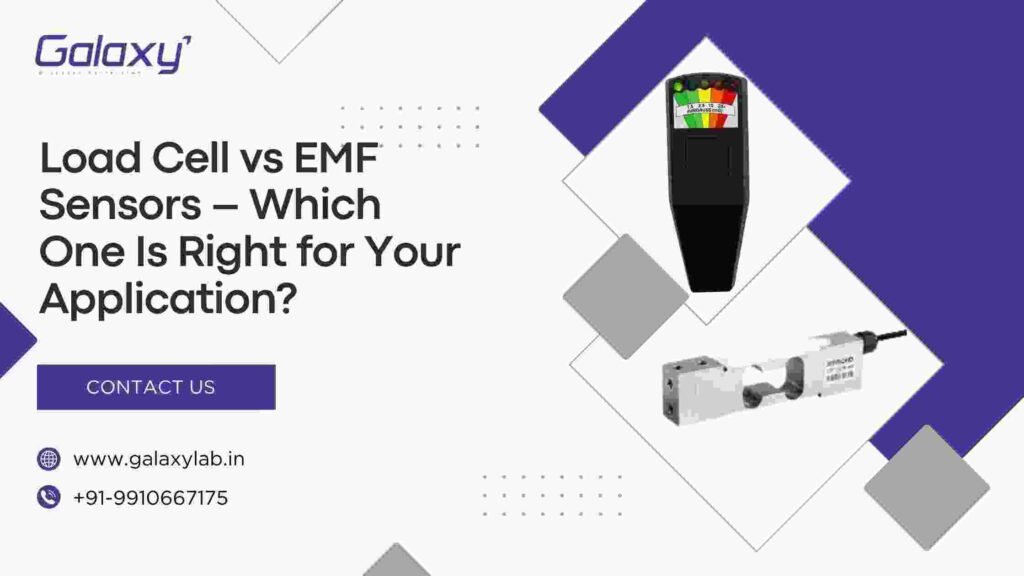
In the world of industrial measurements, choosing the right sensor significantly impacts accuracy, reliability, and performance. The comparison of Load Cell vs EMF Sensors has become increasingly important as industries adopt smarter and more precise technologies. Whether you work in manufacturing, R&D, automation, or quality control, understanding how these two sensing technologies differ will help you pick the best one for your needs.
This blog explains Load Cell vs EMF Sensors from a practical point of view—how they work, where they are used, their advantages, and which one delivers better accuracy for specific applications.
Understanding Load Cells
A load cell is a force-measuring sensor that converts applied load, pressure, or weight into an electrical signal. Most modern load cells use strain gauge technology, where the deformation of metal produces a measurable change in electrical resistance.
Key Features of Load Cells
- High precision for weighing and force measurement
- Excellent long-term stability
- Available in multiple designs (S-type, shear beam, compression, button type)
- Wide load range—from grams to tons
- Ideal for industrial and laboratory use
Load cells are widely used in weighing scales, material testing machines, automation systems, packaging machines, and structural monitoring.
Understanding EMF Sensors
EMF (Electromotive Force) sensors detect voltage generated by electromagnetic fields or induced electrical changes. These sensors are used to measure electrical activity, detect magnetic flux changes, and monitor electromagnetic interference.
Key Features of EMF Sensors
- Detect small voltage or electromagnetic signatures
- Useful for monitoring electrical equipment
- Non-contact sensing capability
- Effective for diagnostics and environmental monitoring
- Suitable for electronics, power systems, and research labs
EMF sensors do not measure force or weight directly; they detect electrical behaviors related to electromagnetic phenomena.
Load Cell vs EMF Sensors: Detailed Comparison
The debate on Load Cell vs EMF Sensors depends largely on what you want to measure. While both are sensors, their working principles and applications are completely different. Below is a side-by-side comparison to help you decide.
1. Measurement Purpose
- Load Cell: Measures weight, force, or load
- EMF Sensor: Measures electromagnetic field strength or voltage
2. Working Principle
- Load Cell: Strain gauge deformation changes resistance
- EMF Sensor: Electromagnetic induction creates measurable voltage
3. Accuracy
- Load Cell: Extremely high accuracy, suitable for precision weighing
- EMF Sensor: Sensitive but can be influenced by external interference
4. Contact Requirement
- Load Cell: Usually requires direct load application
- EMF Sensor: Works without physical contact
5. Applications
- Load Cell: Industrial weighing systems, force testing, automation
- EMF Sensor: Electrical diagnostics, EMI monitoring, scientific research
6. Environment
- Load Cell: Works in harsh industrial environments
- EMF Sensor: Better suited for controlled environments
The comparison of Load Cell vs EMF Sensors clearly shows that both technologies serve completely different purposes, even though both convert physical phenomena into electrical signals.
When Should You Choose a Load Cell?
Opt for a load cell if your requirement is:
- Measuring weight or force
- Precision load monitoring
- Process control in manufacturing
- Testing material strength
- Automation that involves component loading
- Industrial weighing machines
Load cells are the industry standard for any force-related measurement.
When Should You Choose an EMF Sensor?
Choose an EMF sensor if your application includes:
- Monitoring electrical equipment performance
- Detecting electromagnetic fields
- Measuring induced voltage
- Research in physics or electronics
- EMI detection or shielding verification
- Non-contact electrical monitoring
EMF sensors are perfect when electrical or magnetic activity needs to be measured without touching the source.
Final Verdict: Which One Is Better?
The answer to Load Cell vs EMF Sensor depends entirely on the application. If you need force or weight measurement, a load cell is unmatched in accuracy and reliability. But if your application involves electrical or magnetic field monitoring, EMF sensors are the right choice.
Both sensors are excellent—just designed for different purposes. Understanding this difference ensures you select the right instrument and achieve consistently accurate results.
Contact Us
Website: www.galaxylab.in
Phone No.: +91-9910667175
FAQs – Load Cell vs EMF Sensors
1. Are load cells and EMF sensor interchangeable?
No. Load cells measure force or weight, while EMF sensors measure electromagnetic fields or induced voltages. They serve completely different applications.
2. Which sensor is more accurate?
For force or weight measurement, load cells are more accurate. For electromagnetic detection, EMF sensors provide better sensitivity.
3. Can EMF sensors measure load or pressure?
No. EMF sensors cannot measure mechanical load. Only load cells are designed for that purpose.