

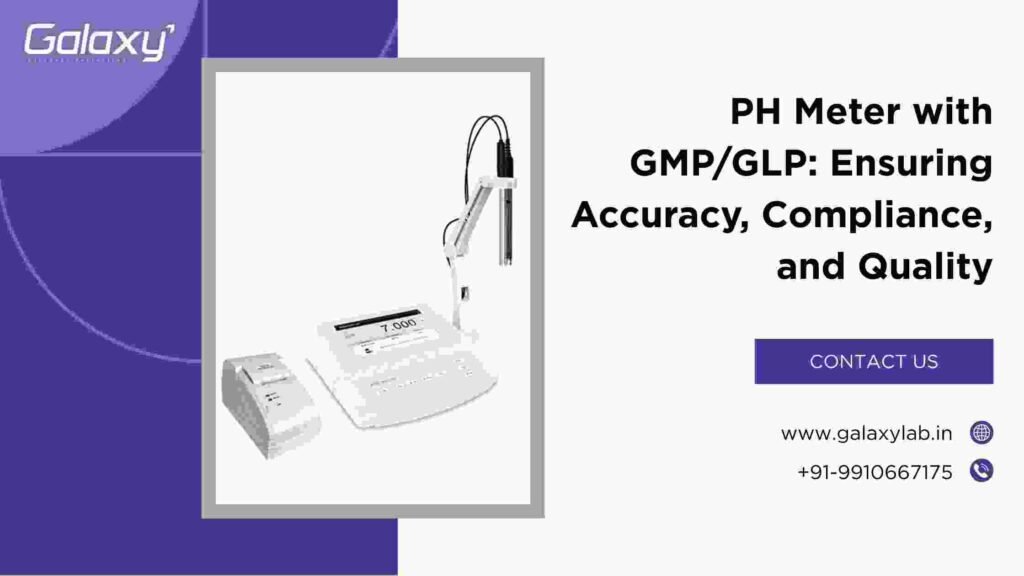
In regulated industries such as pharmaceuticals, biotechnology, food processing, and chemical manufacturing, accurate pH measurement is critical for maintaining product quality and regulatory compliance. However, accuracy alone is no longer sufficient. Laboratories today must also ensure proper documentation, traceability, and data integrity. This is where a PH Meter with GMP/GLP plays a vital role in modern quality-controlled environments.
What is a PH Meter with GMP/GLP?
A PH Meter with GMP/GLP is a laboratory instrument designed to measure pH while complying with Good Manufacturing Practices (GMP) and Good Laboratory Practices (GLP). These meters not only deliver precise pH values but also record calibration history, user activity, and measurement data, making them suitable for regulated laboratories.
Unlike conventional pH meters, GMP/GLP models are designed to support audits and inspections by maintaining complete and transparent records.
Why GMP/GLP Compliance Matters in pH Measurement
In industries governed by strict regulations, every analytical result must be traceable and reproducible. pH plays a key role in formulation stability, chemical reactions, fermentation processes, and quality control. A PH Meter with GMP/GLP ensures that measurements are performed under controlled conditions and properly documented.
During regulatory audits, inspectors often review calibration logs and historical data. Instruments lacking proper documentation may raise compliance concerns, even if measurements are technically accurate.
Essential Features of a PH Meter with GMP/GLP
Modern GMP/GLP-compliant pH meters are designed to support both routine testing and regulatory documentation.
Key Features Include:
- Multi-point calibration with automatic buffer recognition
- Automatic temperature compensation (ATC)
- Secure storage of calibration and measurement data
- Date and time stamping for traceability
- User management and useraccess control and audit trail functions
- Periodic calibration reminder setting
- Optional connectivity to printers or external devices
Some laboratories prefer pH meters with built-in printing capability, as it allows immediate generation of hard-copy records. Instruments such as the Galaxy A-120 (PH Meter with Printer) are often used in such environments where printed documentation is part of standard operating procedures.
Applications in Regulated Industries
A PH Meter with GMP/GLP is widely used across various sectors where compliance and accuracy go hand in hand.
Typical Applications:
- Pharmaceutical manufacturing for raw material and finished product testing
- Biotechnology laboratories handling sensitive biological samples
- Food and beverage processing to ensure safety and consistency
- Chemical industries for reaction control and quality assurance
- Environmental testing laboratories working under regulatory guidelines
In these applications, instruments that offer reliable measurement along with documented output help streamline quality control processes.
Advantages of Using a PH Meter with GMP/GLP
Adopting a compliant pH meter offers several long-term benefits for laboratories.
Key Advantages:
- Supports regulatory compliance and audit readiness
- Ensures data integrity and traceable results
- Reduces manual documentation errors
- Improves consistency through guided calibration
- Enhances confidence in analytical results
A PH Meter with GMP/GLP also helps laboratories standardize workflows, especially when multiple users or shifts are involved.
Choosing the Right PH Meter with GMP/GLP
Selecting the right pH meter depends on laboratory requirements and compliance needs.
Points to Consider:
- Level of data storage and documentation required
- Need for printed records or digital data transfer
- Calibration flexibility and ease of use
- Accuracy, resolution, and durability
- Availability of validation and technical support
For laboratories that prefer instant documentation, models like the Galaxy A-120 (PH Meter with Printer) can integrate smoothly into GMP/GLP workflows without changing existing processes.
Importance of Documentation and Audit Trails
One of the defining strengths of a PH Meter with GMP/GLP is its documentation capability. Audit trails record calibration events, user actions, and measurement history, helping laboratories demonstrate compliance during inspections.
Printed or stored records also support internal quality reviews and corrective actions, making compliance a continuous process rather than a last-minute effort.
Conclusion
In regulated laboratory environments, compliance is just as important as accuracy. A PH Meter with GMP/GLP ensures reliable pH measurement while maintaining complete documentation and traceability. By supporting regulatory requirements and improving data integrity, these instruments help laboratories operate confidently and efficiently. Whether used for routine testing or critical quality control, a GMP/GLP-compliant pH meter is an essential tool for modern laboratories.
Contact Us
Website: www.galaxylab.in
Phone No.: +91-9910667175
FAQs
1. What defines a GMP/GLP-compliant pH meter?
Ans. It includes features such as calibration records, audit trails, time-stamped data, and user accountability.
2. Why is documentation important in pH measurement?
Ans. Documentation ensures traceability and helps laboratories meet regulatory and audit requirements.
3. Can a PH Meter generate printed records?
Ans. Yes, some models support direct printing, which is useful for regulated workflows.
4. Is GMP/GLP compliance required for all laboratories?
Ans. It is essential for regulated industries and highly recommended for quality-focused labs.
5. Can these pH meters be used for daily lab work?
Ans. Yes, a PH Meter is suitable for both routine measurements and compliance-driven applications.