
Description
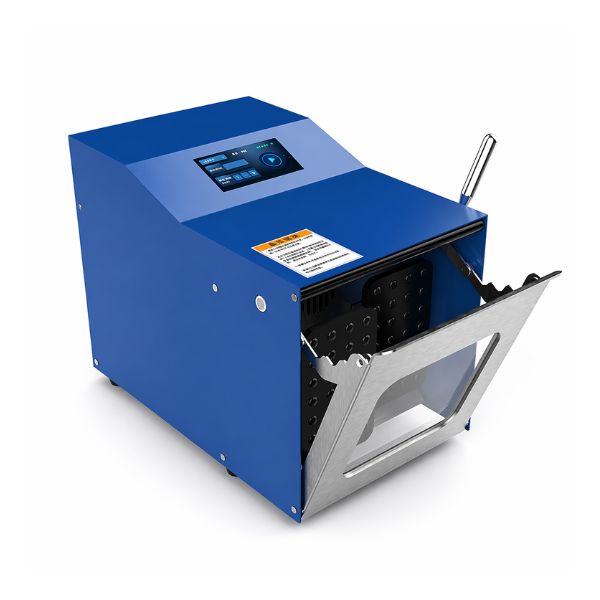
The Paddle Homogenizer is an advanced laboratory instrument designed for efficient, sterile, and reliable sample preparation. Widely used in microbiology, food testing, pharmaceutical research, biotechnology, environmental monitoring, and clinical laboratories, this equipment provides fast and uniform homogenization of solid and semi-solid samples. Using paddle blending technology, the homogenizer creates homogeneous suspensions suitable for analytical testing while minimizing contamination risks and improving laboratory productivity.
This closed-system design reduces contamination risk, improves operator safety, and ensures cleaner sample handling compared to conventional grinding or blending methods.
The operating principle of a Paddle Homogenizer is based on controlled mechanical blending. During operation, the sample is placed inside a sterile homogenization bag along with the required diluent. Two paddles apply controlled pressure and oscillating movement to the bag, crushing and mixing the sample to create a uniform suspension. This process ensures effective extraction of microorganisms, cells, or analytes without generating excessive heat or damaging delicate sample structures.
Their versatility makes them valuable instruments in food safety laboratories, pharmaceutical industries, hospitals, academic institutions, and research facilities.
One of the key advantages of a Paddle Homogenizer is its sterile bag processing technology. This feature is particularly important in microbiological testing where contamination can affect analytical accuracy and result reliability. Disposable sterile bags also eliminate extensive cleaning requirements between samples, allowing faster sample processing and increased laboratory efficiency.
Uniform sample preparation improves analytical precision and supports reliable testing outcomes. The controlled paddle movement ensures efficient mixing while preserving microbial viability and sample integrity, making the system suitable for sensitive microbiological and biological applications.
Digital interfaces and programmable settings simplify operation and help laboratories maintain repeatable sample preparation protocols. Real-time monitoring functions improve process control and support consistent laboratory workflows.
Durability and hygienic design are important aspects of Paddle Homogenizers. Smooth internal surfaces and easy-access components simplify cleaning and maintenance while ensuring hygienic operation and contamination-free sample processing.
The gentle blending mechanism used in Paddle Homogenizers prevents excessive heat generation and minimizes structural damage to delicate samples. This makes the equipment highly suitable for microbiological investigations, pathogen detection, tissue analysis, pharmaceutical quality testing, and biological sample preparation. Efficient homogenization also improves extraction efficiency and enhances analytical sensitivity.
The compact design of a Paddle Homogenizer allows convenient installation in laboratories with limited bench space. Low-noise operation improves laboratory comfort during routine processing, while energy-efficient performance helps reduce operational costs without compromising homogenization quality. These features make the instrument practical for both routine and specialized laboratory applications.
In pharmaceutical and biotechnology laboratories, they support formulation testing, microbial analysis, and biological research. Environmental testing laboratories also use paddle homogenizers for preparing soil, water, and environmental specimens for analysis.
These features ensure dependable sample preparation and improved laboratory efficiency across various applications.
Its advanced blending technology and versatile application range make it an essential instrument for food, pharmaceutical, microbiological, and research laboratories.