

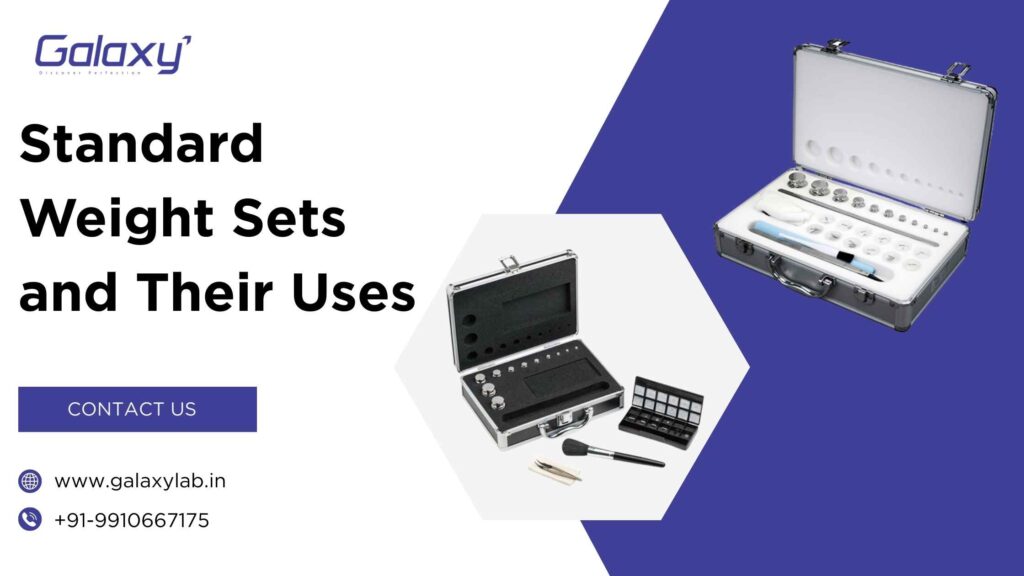
When I talk about accuracy in laboratories, calibration always comes first. No matter how advanced an instrument is, its performance depends on how precisely it is calibrated. This is where Standard weight sets and their uses become absolutely essential. From analytical balances to industrial weighing systems, these calibrated weights form the backbone of reliable measurement.
In this blog, I’ll walk you through what standard weight sets are, why they matter, and how they are used across different industries.
What Are Standard Weight Sets?
Standard weight sets are precision-manufactured weights used to verify, calibrate, and adjust weighing instruments. Each weight is produced according to international standards such as OIML or ASTM and is tested for mass accuracy, density, and surface finish.
In my experience, understanding Standard weight sets and their uses is critical for anyone working in laboratories, manufacturing units, or quality control departments.
These sets usually come in protective boxes and include weights of varying denominations, allowing users to perform both routine checks and high-precision calibration.
Why Accuracy Depends on Standard Weight Sets
Accuracy in weighing is not optional—it directly affects product quality, compliance, and research outcomes. I’ve seen even small deviations create major issues in pharmaceuticals, chemicals, and food testing.
Here’s why Standard weight sets and their uses play a vital role:
- They ensure balances deliver consistent results
- They help maintain traceability to national and international standards
- They reduce errors caused by drift or environmental changes
- They support regulatory compliance and audits
Without proper calibration using standard weights, even the best balance can produce unreliable data.
Applications Across Industries
One of the reasons standard weights are so valuable is their versatility. I’ve personally seen Standard weight sets and their uses across multiple sectors.
Key Areas of Use
- Analytical laboratories for balance calibration
- Pharmaceutical manufacturing for GMP compliance
- Chemical and research labs for accurate formulation
- Industrial weighing systems for process control
- Educational institutes for training and demonstrations
- Calibration laboratories for traceable verification
Each application relies on precise mass values to maintain accuracy and trust in measurement results.
How Standard Weight Sets Are Used in Calibration
Calibration is not just about placing a weight on a balance—it’s a systematic process. I always recommend following proper procedures to get the best results.
Typical steps include:
- Cleaning the balance and weights before use
- Allowing weights to reach room temperature
- Applying weights carefully using forceps or gloves
- Recording deviations and adjusting the balance if required
When you truly understand Standard weight sets and their uses, calibration becomes a powerful tool rather than a routine task.
Storage and Handling Best Practices
Even the most accurate weight set can lose its reliability if mishandled. I’ve learned that proper care is just as important as precision manufacturing.
Best Practices
- Store weights in protective cases
- Avoid touching weights with bare hands
- Clean weights regularly using recommended methods
- Keep them away from corrosive environments
Correct handling ensures Standard weight sets and their uses remain effective for years.
Choosing the Right Standard Weight Set
Selecting the correct weight set depends on your balance type, accuracy requirements, and industry standards. I always advise users to match the weight class with their balance readability.
If your balance reads to 0.1 mg, for example, you’ll need higher-accuracy weights than a balance used for routine industrial checks. This thoughtful selection ensures maximum value from Standard weight set and their uses.
Conclusion
To me, precision is not just a technical requirement—it’s a commitment to quality. Standard weight set and their uses form the foundation of accurate weighing, reliable calibration, and regulatory compliance. Whether you work in a laboratory, manufacturing unit, or calibration facility, investing in the right standard weights ensures confidence in every measurement you make.
Contact Us
Website: www.galaxylab.in
Phone No.: +91-9910667175
FAQs
Q1. How often should standard weights be used for calibration?
Ans. I recommend routine checks daily or weekly, depending on usage, and full calibration at defined intervals or before audits.
Q2. Are all standard weight set the same?
Ans. No. They vary by accuracy, class, material, and application. Selecting the correct class is essential.
Q3. Can standard weights lose accuracy over time?
Ans. Yes, improper handling, contamination, or corrosion can affect accuracy, which is why proper storage and periodic recalibration are important.
Q4. Which industries rely most on standard weight set?
Ans. Pharmaceuticals, laboratories, research centers, food processing, and industrial manufacturing heavily depend on them.