

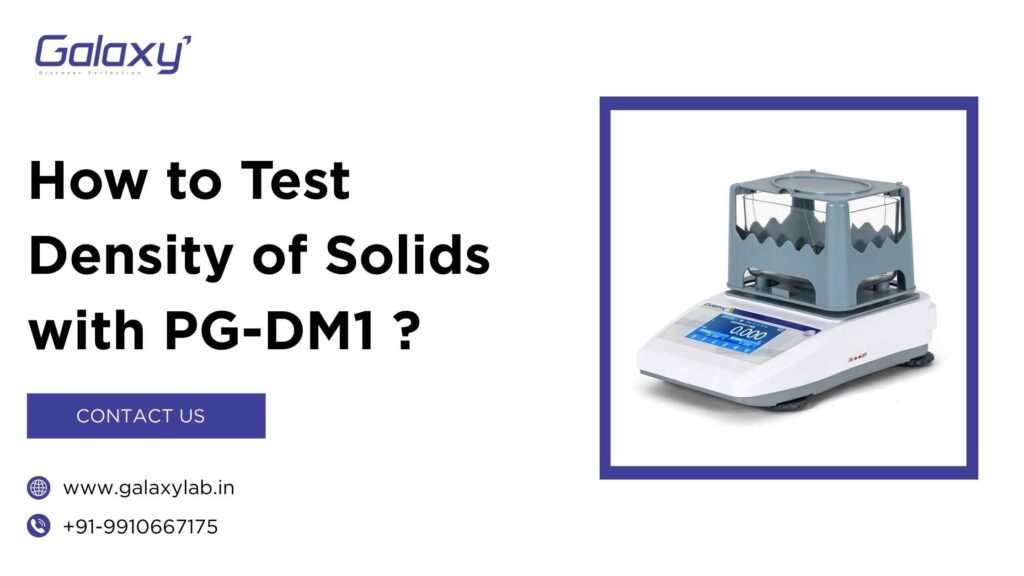
In laboratories, manufacturing units, jewelry testing centers, and quality control departments, density measurement is one of the most essential parameters. Whether it is metal, plastic, rubber, ceramics, or gemstones – knowing density helps identify purity, material quality, and authenticity. Today, modern labs rely on digital density meters instead of manual calculations to get fast and reliable results. That is why many professionals ask: How to test density of solids with PG-DM1 ? This guide explains the complete process, practical steps, benefits, and why PG-DM1 is considered one of the most trusted density meters in industries.
What is PG-DM1 Density Meter?
Before learning How to test density of solids with PG-DM1 ?, let’s understand what the device is. PG-DM1 is a digital solid density meter designed to deliver accurate density and specific gravity values using the Archimedes Principle.
It is widely used in:
- Metal testing (Gold, Silver, Copper, Alloys)
- Plastic and Rubber industry
- Ceramics and Powders
- Gemstone authentication
- Research laboratories
- Automotive R&D departments
Why Density Testing is Important?
Density plays a major role in identifying if a material is pure, mixed, or counterfeit. For example, in the jewelry industry, density is used to confirm whether gold is pure or adulterated. In plastic manufacturing, density helps maintain consistency in product batches.
Key reasons include:
- Detecting purity
- Maintaining quality control
- Ensuring material standards
- Comparing sample behavior
- Meeting industrial certifications
Understanding How to test density of solids with PG-DM1 ? makes the testing process easier and faster for users.
Step-by-Step: How to Test Density of Solids with PG-DM1 ?
Here is a clear breakdown:
Prepare the Device
- Place PG-DM1 on a stable table.
- Connect the power and turn it ON.
- Ensure the weighing pan and water container are clean.
Calibration
- Perform automatic calibration (usually with the “CAL” button).
- Calibration helps ensure the most accurate measurement.
Place Sample in Air
- Keep the solid sample on the weighing pan.
- The system measures the first weight – Weight in Air (A).
Place Sample in Water
- Suspend the same sample using the accessory hook.
- Lower it into the water container.
- The system measures Weight in Water (B).
Automatic Density Calculation
- Once both weights are recorded, PG-DM1 instantly calculates:
Density = Weight in Air / (Weight in Air – Weight in Water) - The screen displays density and sometimes specific gravity directly.
This entire process is what defines How to test density of solids with PG-DM1 ? – quick, automatic, and error-free.
Benefits of Testing Density Using PG-DM1
Advantages
- Fast results within seconds
- 99.99% precision – ideal for lab and QC use
- Easy operation – even for non-technical staff
- Digital reading avoids human error
- Supports different materials – metals, plastic, rubber, ceramics
- Low operating cost
Who should use it?
- Jewelry shop owners
- Industrial QC labs
- Schools & universities
- Metal workshops
- Factory R&D departments
Practical Tips While Using PG-DM1
To increase accuracy, keep these practical tips in mind:
- Use distilled water for standard testing
- Use diesel for gold jewellery testing
- Avoid air bubbles on samples by wiping gently
- Keep water/liquid temperature around 25°C (standard measurement condition)
- Re-calibrate every day for best results
These tips complement the process of How to test density of solids with PG-DM1 ? and ensure reliable output every time.
Real-Life Use Case Example
Let’s assume a jewelry shop receives a gold coin and needs to verify purity. This simplifies business decisions, enhances trust, and avoids disputes.
Conclusion
This digital tool is perfect for industries where precision matters. It saves time, avoids manual math, boosts accuracy, and enhances quality control.
Contact Us
Website: www.galaxylab.in
Phone No.: +91-9910667175
FAQs
1. What is the accuracy level of PG-DM1?
Ans. PG-DM1 provides high-precision measurement suitable for scientific and industrial use.
2. Can beginners use PG-DM1 easily?
Ans. Yes, once you learn How to test density of solids with PG-DM1 ?, even non-technical users can operate it comfortably.
3. How long does one test take?
Ans. Usually 30-45 seconds, depending on material type.