


Spectrophotometers play a critical role in laboratories across pharmaceuticals, research, food testing, environmental analysis, and education. These instruments are trusted to deliver accurate absorbance and transmittance readings that directly impact analytical results. However, even high-quality instruments can drift over time.
That’s why understanding the Common Validation Tests for Spectrophotometers is essential for maintaining measurement reliability, regulatory compliance, and consistent performance.
Why Validation Tests Are Essential for Spectrophotometers
Routine validation confirms that a spectrophotometer operates within defined specifications. These tests help detect optical misalignment, lamp aging, wavelength drift, or detector issues before they affect sample results.
Let’s explore each validation test in detail.
1. Control of Wavelength / Wavelength Accuracy Test
Wavelength accuracy verifies that the instrument measures light at the correct wavelength. Even a small deviation can significantly affect absorbance values, especially in UV-Visible applications.
How it works:
1. Weight accurately 1.0 gm of Holmium Oxide and dissolve it in 1.4 M Perchloric acid solution. Makeup to 25 ml with the same solvent.
2. Go to the Wavelength Scanning mode of the Spectrophotometer. Set the wavelength range from 200nm to 700nm and the absorption range as 0 to 3 Abs.
3. Then fill the Cuvette with 1.4M Perchloric acid and put in the sample cubicle and press reference to zero.
4. After auto zero put the Holmium perchlorate solution in sample cell holder and then press Start key.
5. Scan it and verify the wavelength using absorption maxima of Holmium Perchlorate solution. The permitted tolerance is given in the table below:
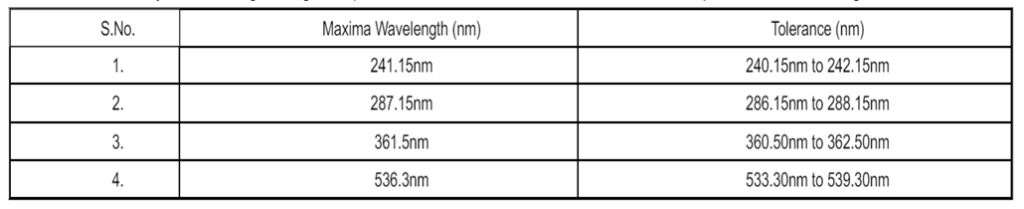
Or if you do not want to prepare fresh reagents you can directly use a Glass Holmium Filter and match the peaks with the graph below:

Permitted Tolerance:
+ 1 nm for range 200 nm to 400 nm
+ 3 nm for range 400 nm to 600 nm
+ 3 nm for range 600 nm to 800 nm
2. Control of Absorbance / Photometric Accuracy Test
Photometric accuracy evaluates whether absorbance readings match certified values. This test confirms the detector’s ability to measure light intensity correctly.
1. Dry a quantity of the Potassium dichromate by heating to constant weight at 130°C.
2. Weight accurately about 60 mg of dried potassium dichromate and dissolve it in 0.005M sulphuric acid solution. Make up to 1000 ml with the same solvent. Mark the solution as (A).
3. Weight accurately about 60 mg of dried potassium dichromate and dissolve it in 0.005M sulphuric acid solution. Make up to 100 ml with the same solvent. Mark the solution as (B).
4. Go to the Multi-Wavelength mode of the Spectrophotometer. Set the wavelengths as 235nm, 257nm, 313nm, 350nm
5. Then fill the Cuvette with 0.005M Sulphuric acid for blank and put in both sample cell holder and reference cell holder and press Zero to blank.
6. After auto zero put the Potassium Dichromate solution labelled as solution ‘A’ in sample cubicle then press start key taking absorbance individually for first four wavelengths mentioned in ‘Table I’. Now take these readings and write them down.
7. Now remove the sample, put the 0.005M Sulphuric acid for blank and put in both sample cell holder and reference cell holder. Now set the wavelength as 430nm. Press Zero to blank.
8. Put the solution label ‘B’ in the sample cell holder and press Measure key to take the reading.
9. Now take these readings and write them down.Note the absorption maxima of Potassium Dichromate solution at a different wavelength and calculate the ‘Specific Absorbance’formula and tolerance is given in below table.

Specific Absorbance = Absorbance measured x 1 x Volume made(ml) / 100*weight of Potassium Dichromate (gm)
3. Stray Light Test
Stray light refers to unwanted light reaching the detector, which can distort absorbance readings—particularly at high absorbance levels.
How it is tested:
1. Dry a quantity of the Potassium chloride by heating to constant weight at 130°C.
2. Weight accurately 1.20 g of dried potassium chloride and dissolve it in 50 ml distilled water.
3. Make upto 100 ml with the same solvent.
4. Go to the Photometer mode of the Spectrophotometer. Set the wavelengths as 200nm.
4. Check the absorbance of above solution using water as a blank at 200 nm.
5.4.6 Absorbance should be greater than 2.0
Controlling stray light is a core element of the Common Validation Tests for Spectrophotometers, as excessive stray light reduces analytical accuracy.
Implementing a Regular Validation Schedule
For best results, laboratories should perform validation:
- During installation (IQ)
- After major maintenance
- At scheduled intervals (monthly or quarterly)
- Before critical analytical runs
Documenting the Common Validation Tests for Spectrophotometers also supports audits and demonstrates commitment to quality management systems.
Conclusion
Reliable spectrophotometric results start with proper instrument validation. By routinely performing the Common Validation Tests for Spectrophotometers—wavelength accuracy, photometric accuracy, stray light, and baseline flatness—laboratories can safeguard data quality, meet regulatory expectations, and extend equipment lifespan.
These tests are not just technical checks; they are essential quality assurance tools that protect research integrity and operational efficiency. Integrating them into standard laboratory workflows ensures every measurement is built on a foundation of accuracy and trust.
Contact Us
Website: www.galaxylab.in
Phone No.: +91-9910667175
FAQs
Q1. How often should spectrophotometer validation be performed?
Ans. Validation frequency depends on laboratory protocols, but most facilities conduct the Common Validation Tests for Spectrophotometers monthly or quarterly, and always after servicing.
Q2. Are certified reference materials required for validation?
Ans. Yes. Certified filters or solutions are recommended to ensure traceable and reliable results during wavelength and photometric accuracy testing.
Q3. Can validation be performed in-house?
Ans. Many labs perform routine checks internally, while annual comprehensive validation is often handled by qualified service providers.
Q4. What happens if a validation test fails?
Ans. If any of the Common Validation Tests for Spectrophotometers fail, the instrument should be recalibrated or serviced before further analytical use.
Q5. Do validation tests support regulatory compliance?
Ans. Absolutely. These tests help meet GLP, GMP, ISO, and other quality standards by providing documented evidence of instrument performance.