

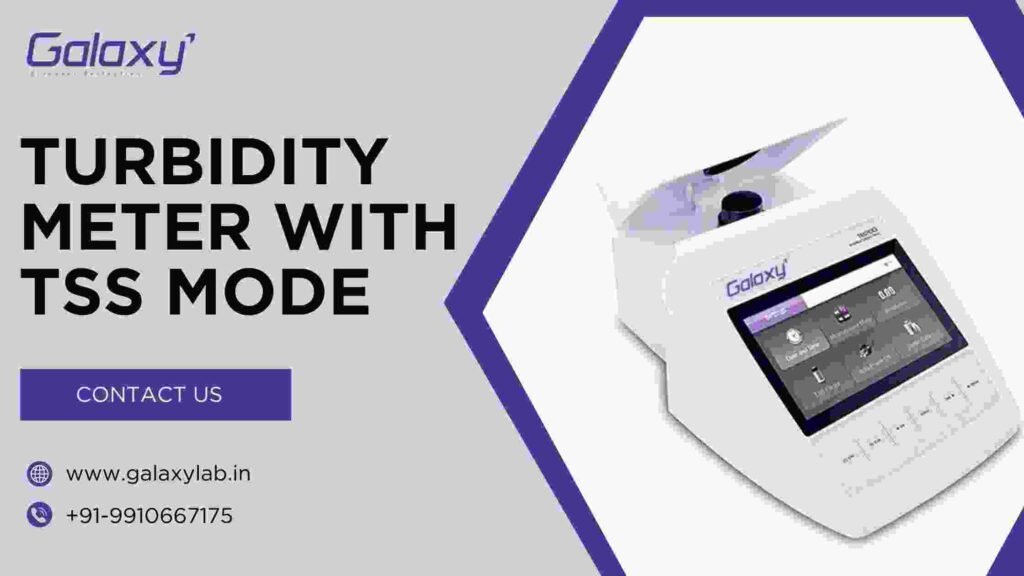
Water quality testing is essential across laboratories, industries, wastewater treatment plants, and environmental monitoring departments. One of the most efficient and modern instruments used in this field is the Turbidity Meter with TSS Mode. This advanced device measures both turbidity and Total Suspended Solids (TSS), making it highly valuable for professionals who need quick, accurate, and combined testing results. If you are looking for a dual-function instrument that saves time and provides reliable data, this guide will help you understand its working, applications, features, and usage—along with important information on TSS conversion.
What is a Turbidity Meter with TSS Mode?
A Turbidity Meter with TSS Mode measures the cloudiness or haziness of water caused by suspended particles. Standard turbidity meters measure only turbidity in NTU (Nephelometric Turbidity Units). However, modern systems include TSS Mode, which measures Total Suspended Solids in mg/L or ppm.
This dual functionality allows the user to test both parameters using a single device, reducing the need for multiple instruments and improving overall testing efficiency.
Why You Need a Turbidity Meter with TSS Mode
Using one instrument to measure two major water quality parameters is highly convenient. A Turbidity Meter with TSS Mode eliminates manual TSS calculation and offers instant results based on pre-configured calibration curves.
Key Benefits:
- Dual-Parameter Measurement: Measures turbidity (NTU) and TSS (mg/L) instantly.
- Time-Saving Operation: No manual TSS calculations required.
- High Accuracy: Stable optical sensors ensure precise readings.
- Versatile Usage: Effective in wastewater testing, drinking water systems, and environmental surveys.
- Easy Handling: Digital display, simple interface, and quick calibration options.
This combination of accuracy and convenience makes it suitable for routine and advanced water analysis.
How Does a Turbidity Meter with TSS Mode Work?
The meter operates on the light scattering principle, also known as nephelometry.
Working Process:
- A LED light source passes through the water sample.
- Suspended particles scatter the incoming light.
- A detector placed at a 90° angle measures scattered light intensity.
- Turbidity is displayed in NTU.
- For TSS Mode, the device uses calibration factors or algorithms to convert turbidity signals into estimated TSS values.
- Results appear instantly on the screen in both NTU and mg/L.
This technology ensures quick and dependable measurement for various sample types with different clarity levels.
Key Features of a Turbidity Meter with TSS Mode
Most models offer several advanced features, including:
- High-precision NTU measurement
- Dual turbidity and TSS measurement
- Backlit digital LCD
- Auto-range capability
- Stable optical sensing system
- Multi-point calibration
- Data logging and storage
- Portable and benchtop versions
- Auto power-off
- Easy-to-clean cuvette chamber
These features help maintain accuracy and extend instrument life.
Applications of Turbidity Meter with TSS Mode
- The device is widely used in multiple testing environments:
- Wastewater Treatment Plants: Ensures effluent meets regulatory discharge standards.
- Environmental Monitoring: Tracks particle concentration in rivers, lakes, and groundwater.
- Drinking Water Treatment Systems: Monitors clarity and filtration performance.
- Food & Beverage Industry: Helps maintain product clarity and process quality.
- Chemical & Pharmaceutical Labs: Useful for production, process monitoring, and wastewater checks.
Its flexibility and reliability make it a preferred tool for professionals working with water samples.
Important Note on TSS Conversion – Please Read
1. No Universal Conversion for TSS
There is no standard or universal conversion table for TSS.
The relationship between turbidity (NTU) and Total Suspended Solids (mg/L) is highly sample-dependent and is influenced by particle size, shape, density, and the nature of the water source.
Because this relationship is not linear, a single formula or fixed conversion value cannot accurately convert turbidity into TSS across all types of samples.
2. Measuring TSS Using Turbidity
To obtain TSS values through turbidity readings, the instrument requires a sample-specific conversion factor.
Once this conversion factor is established for a particular water source, the meter can reliably calculate TSS for similar samples without additional laboratory testing. This enables quick, on-site estimation of TSS using turbidity data.
3. Determining the TSS Conversion Factor
The procedure for determining the correct conversion factor is detailed in the instrument manual.
Please refer to Page 6 for the complete step-by-step method.
In summary, the process involves comparing turbidity readings with laboratory-verified TSS measurements to establish a correlation curve. This correlation is then programmed into the meter to ensure accurate, sample-specific TSS calculations.
Buying Guide – Choosing the Right Turbidity Meter with TSS Mode
Before purchasing, consider these important points:
- Measurement Range: Suitable for your required turbidity levels.
- Calibration Options: Multi-point calibration helps maintain accuracy.
- Accuracy Level: Prefer models with ±2% or better precision.
- Portability: Choose handheld for fieldwork or benchtop for lab use.
- Data Logging: Helpful for documentation and record keeping.
The right meter ensures long-term efficiency and dependable performance.
Maintenance Tips
To extend the lifespan of your instrument:
- Keep cuvettes clean and scratch-free
- Avoid touching cuvette surfaces with fingers
- Calibrate regularly
- Use certified standards
- Store in a dry place
- Replace batteries when required
Proper care ensures consistent accuracy.
Conclusion
A Turbidity Meter with TSS Mode is an essential instrument for modern water quality testing. Its dual measurement capability, accuracy, and ease of use make it ideal for environmental monitoring, wastewater management, laboratories, and industrial applications. By understanding TSS conversion and following the correct calibration process, users can achieve highly accurate results tailored to their specific water source.
Contact Us
Website: www.galaxylab.in
Phone: +91-9910667175
FAQs – Turbidity Meter with TSS Mode
Q1. Does TSS measure turbidity?
Ans. No. TSS measures solid particles (mg/L), whereas turbidity measures light scattering (NTU).
Q2. What is the use of a TSS meter?
Ans. It is used to measure suspended solids concentration in wastewater and environmental samples.
Q3. What is the working principle of a turbidity meter?
Ans. It works on the light scattering principle.
Q4. What is the difference between turbidity and TSS?
Ans. Turbidity shows cloudiness (NTU), while TSS shows solid content (mg/L).
Q5. Is the instrument portable?
Ans. Yes, it is available in both portable and benchtop models.