

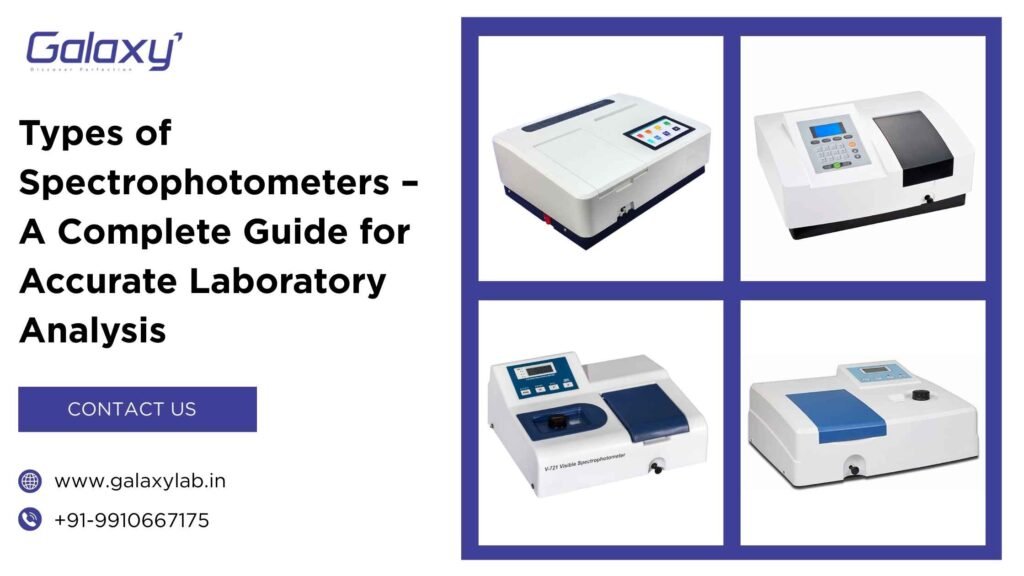
Spectrophotometers play a crucial role in laboratories, research centers, industries, and quality-control departments. These instruments measure how much light a sample absorbs, helping users determine concentration, purity, and chemical composition. Understanding the Types of Spectrophotometers is important for selecting the right device for your specific application. This guide explains each type clearly, from a practical point of view, so you can make the best decision for your workflow.
What Is a Spectrophotometer?
A spectrophotometer is an analytical instrument that measures the interaction between light and matter. It sends light through a sample and detects how much is absorbed or transmitted. This data helps identify substances and quantify concentrations with high precision. Different Types of Spectrophotometers exist because every industry and application requires specific light ranges, accuracy levels and analysis methods.
Popular Types of Spectrophotometers
Below are the most widely used Types of Spectrophotometers, along with their features, uses, and advantages. Each type is designed to solve particular laboratory challenges and provide the most reliable results.
1. UV-Visible Spectrophotometers
UV-Visible (UV-Vis) spectrophotometers analyze samples using ultraviolet and visible light (190–1100 nm). These are the most commonly used Types of Spectrophotometers due to their versatility.
Key Features
- Measures absorbance and transmittance
- Suitable for chemicals, biological samples, solutions
- Offers high accuracy and repeatability
- Ideal for routine lab testing
Common Applications
- Concentration measurement
- DNA/RNA purity analysis
- Pharmaceutical quality control
- Water and wastewater testing
2. Infrared (IR) Spectrophotometers
IR spectrophotometers measure how samples absorb infrared radiation. These instruments are essential for identifying chemical bonds and molecular structures.
Key Features
- Works in mid-infrared and near-infrared ranges
- Provides detailed molecular information
- Ideal for solids, liquids, and powders
Common Applications
- Organic chemistry analysis
- Food and agriculture testing
- Polymer and plastic identification
- Pharmaceutical raw material verification
Among the Types of Spectrophotometers, IR units are preferred for structural and qualitative analysis.
3. Fluorescence Spectrophotometers
These spectrophotometers measure the fluorescence emitted by samples after they absorb light. They are designed for extremely sensitive detection.
Key Features
- Detects very low concentration levels
- High specificity for biological samples
- Excellent for molecular interaction studies
Common Applications
- Protein and enzyme analysis
- Medical and clinical diagnostics
- Biochemistry and biotechnology research
This is one of the Types of Spectrophotometers used when ultra-low detection limits are required.
4. Atomic Absorption Spectrophotometers (AAS)
AAS instruments are used to measure the concentration of metal elements in samples by analyzing how atoms absorb specific wavelengths.
Key Features
- Highly accurate metal detection
- Works for liquids, environmental samples, and minerals
- Suitable for trace analysis
Common Applications
- Heavy metal testing
- Food safety inspections
- Soil and mineral analysis
- Clinical toxicology
AAS is one of the specialized Types of Spectrophotometers for quantitative elemental analysis.
5. Portable Spectrophotometers
Portable spectrophotometers offer flexibility for field testing and on-site measurements.
Key Features
- Compact and user-friendly
- Ideal for outdoor and real-time sampling
- Provides quick and reliable results
Common Applications
- Water quality testing
- Environmental monitoring
- Industrial inspections
- Food and beverage quality checks
Many industries rely on this category of Types of Spectrophotometers for fast decision-making without lab dependency.
6. Double Beam Spectrophotometers
This improves accuracy and minimizes errors caused by light fluctuations.
Key Features
- Real-time comparison
- More stable and reliable readings
- Reduced drift and noise
Common Applications
- Research laboratories
- Quality control departments
- High-precision chemical testing
These advanced Types of Spectrophotometers offer enhanced stability for continuous measurements.
How to Choose the Right Spectrophotometer?
When evaluating different Types of Spectrophotometers, consider the following factors:
Important Points to Consider
- Wavelength Range Needed: UV, Visible, IR, or multi-range
- Sample Type: Liquid, solid, powder, biological, or chemical
- Accuracy and Sensitivity: Routine testing or high-precision research
- Portability: Lab-based or field-based applications
- Budget and Maintenance Costs: Consumables, lamps, and calibration requirements
- Matching these points with your application helps you pick the perfect instrument.
Conclusion
Understanding the various Types of Spectrophotometers allows laboratories and industries to choose the most accurate and efficient tool for their analysis needs. From UV-Vis and IR models to AAS and portable units, each type offers unique advantages. Your choice should depend on your sample type, required wavelength range, and application complexity. With the right spectrophotometer, you can achieve consistent, reliable, and high-quality results in every test.
Contact Us
Website: www.galaxylab.in
Phone No.: +91-9910667175
FAQs – Types of Spectrophotometers
1. Why are there different types of spectrophotometers?
Ans. Because different samples and applications require specific wavelength ranges, sensitivity levels, and measurement techniques.
2. Which spectrophotometer is best for chemical concentration measurement?
Ans. UV-Visible spectrophotometers are the most commonly used for concentration and purity testing.
3. Which type is used for metal analysis?
Ans. Atomic Absorption Spectrophotometers (AAS) are ideal for testing metal concentration.
4. Can portable spectrophotometers replace laboratory units?
Ans. They are useful for field testing, but laboratory units offer higher accuracy and advanced features.
5. What factors should I check before buying a spectrophotometer?
Ans. Check wavelength range, accuracy, application, sample type, and maintenance requirements.