

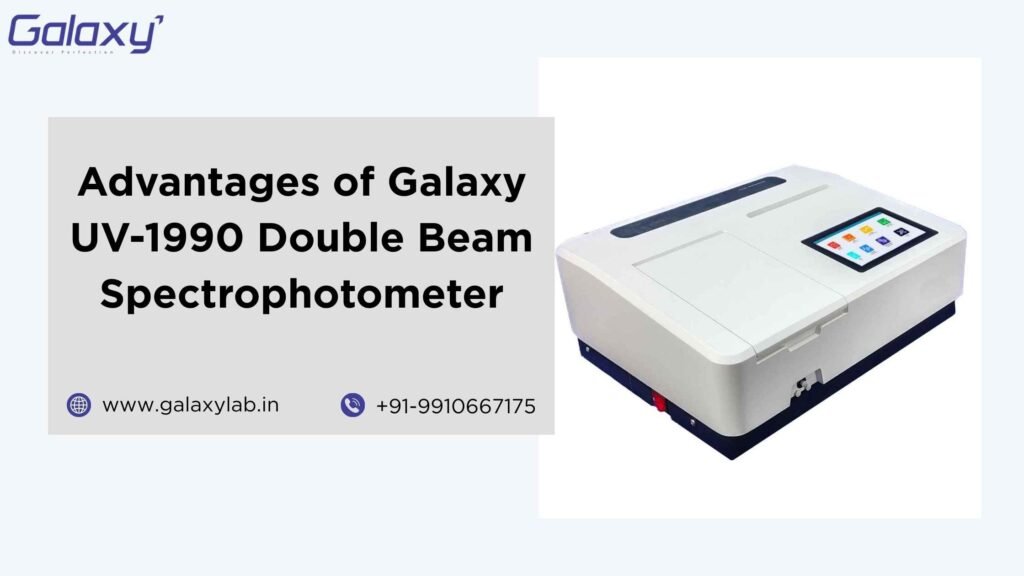
In modern analytical laboratories, accuracy, speed, and reliability define performance. Among advanced optical instruments, the Galaxy UV-1990 Double Beam Spectrophotometer stands out as a powerful solution for precise UV-Visible measurements. Designed to meet the demands of pharmaceutical, chemical, academic, and industrial laboratories, this instrument delivers consistent results while simplifying routine analysis.
This article explores the key advantages of the Galaxy Double Beam Spectrophotometer and explains why it is considered a dependable choice for today’s quality-driven environments.
What Is the Galaxy UV-1990 Double Beam Spectrophotometer?
The Galaxy Double Beam Spectrophotometer is a high-performance analytical device used to measure absorbance and transmittance of samples across a wide wavelength range covering both UV and visible regions. Unlike single-beam models, its double-beam optical system simultaneously compares the sample and reference, ensuring superior stability and accuracy throughout every measurement.
Equipped with optimized spectral bandwidth, high-quality Japanese lamps, and a Japanese detector, the instrument delivers excellent optical precision and signal stability. Its modern touchscreen interface and computer connectivity further enhance ease of operation and data management, making it ideal for applications such as assay analysis, concentration determination, kinetic studies, and quality control testing.
Key Advantages of Galaxy UV-1990 Double Beam Spectrophotometer
1. Superior Measurement Accuracy
One of the primary advantages of the Galaxy Double Beam Spectrophotometer is its exceptional accuracy. The double-beam configuration automatically compensates for light source fluctuations, while the narrow spectral bandwidth improves peak resolution and analytical sensitivity. Combined with Japanese lamps and detector technology, this ensures highly reliable results—even during extended analytical runs.
2. High Stability for Continuous Operations
Laboratories performing repetitive or long-duration measurements benefit from outstanding photometric stability. The Galaxy UV-1990 Double Beam Spectrophotometer maintains a consistent baseline, minimizing drift and reducing the need for frequent recalibration.
3. Wide Wavelength Range for Versatile Applications
With its broad wavelength range across UV and visible spectra, this spectrophotometer supports diverse analytical tasks, including:
- Pharmaceutical assays
- Biochemical research
- Environmental testing
- Food and beverage analysis
- Academic experiments
This versatility makes the Galaxy UV-1990 Double Beam Spectrophotometer suitable for multiple industries and laboratory environments.
4. User-Friendly Touchscreen Interface
Ease of use is another major benefit. The integrated touchscreen allows operators to set parameters quickly, store methods, and access results with minimal training. This intuitive operation reduces errors and significantly improves laboratory productivity.
5. Fast Scanning and Efficient Sample Handling
Time efficiency matters in high-throughput labs. The Galaxy UV-1990 Double Beam Spectrophotometer offers rapid scanning speeds and responsive data processing. Its 4-cell cuvette holder enables simultaneous handling of multiple samples or standards, improving workflow efficiency and throughput.
6. Robust Construction with Japanese Optical Components
Built with durable optics, stable electronics, Japanese lamps, and a Japanese detector, the system is engineered for continuous laboratory use. This robust construction ensures long-term reliability while lowering maintenance and operational costs.
7. Advanced Data Handling and Computer Connectivity
Modern laboratories require seamless documentation. The Galaxy UV-1990 Double Beam Spectrophotometer supports computer connectivity for data transfer, storage, and report generation. This simplifies record-keeping and supports compliance requirements in regulated industries.
Why Choose a Double Beam System?
Double-beam technology offers clear advantages over single-beam instruments. By measuring sample and reference simultaneously, the Galaxy UV-1990 Double Beam Spectrophotometer minimizes errors caused by lamp aging or environmental changes. This results in:
- Improved baseline stability
- Greater measurement precision
- Reduced manual corrections
- Higher confidence in analytical outcomes
For quality-focused laboratories, this design ensures consistent and reproducible data.
Applications Across Multiple Industries
The Galaxy UV-1990 Double Beam Spectrophotometer is widely used in:
- Pharmaceutical quality control
- Chemical research and formulation
- Biotechnology and life sciences
- Environmental monitoring
- Educational laboratories
Its adaptability allows organizations to standardize multiple analytical procedures using a single reliable platform.
Conclusion
The Galaxy Double Beam Spectrophotometer combines precision, stability, and user-friendly operation into one advanced analytical solution. With optimized spectral bandwidth, wide wavelength range, touchscreen operation, Japanese lamps and detector, 4-cell cuvette holder, and computer connectivity, it delivers dependable UV-Visible analysis for modern laboratories.
For organizations seeking accuracy, efficiency, and long-term reliability, the Galaxy Double Beam Spectrophotometer offers measurable advantages—helping laboratories maintain high standards while improving workflow productivity.
Contact Us
Website: www.galaxylab.in
Phone No.: +91-9910667175
FAQs
Q1. What makes the Galaxy Double Beam Spectrophotometer different from single-beam models?
Ans. Its double-beam design simultaneously measures sample and reference, providing higher accuracy and stability compared to single-beam instruments.
Q2. Is the Galaxy UV-1990 Double Beam Spectrophotometer suitable for pharmaceutical labs?
Ans. Yes, it is widely used in pharmaceutical quality control for assays, concentration measurements, and compliance testing.
Q3. Can beginners operate this spectrophotometer easily?
Ans. Absolutely. The touchscreen interface and simple controls allow new users to perform measurements with minimal training.
Q4. Does the instrument support data storage and reporting?
Ans. Yes, computer connectivity enables digital data storage and analytical report generation.
Q5. What industries commonly use the Galaxy Double Beam Spectrophotometer?
Ans. It is commonly used in pharmaceuticals, chemicals, biotechnology, environmental testing, food analysis, and academic research.